Poor RTO Policy Is Destroying the Case for Good Office Design
- Admin

- Apr 1
- 5 min read

We are in the business of designing workplaces. We believe deeply that a well-designed office can change how people think, collaborate, and create. We have seen it happen — again and again.
Which is exactly why the current wave of blunt, top-down, five-day return-to-office mandates frustrates us professionally. These policies aren't saving the office. They're sabotaging it.
Not because the office doesn't have value. But because poor policy is poisoning the well for great design.

The Experiment Nobody Asked For — But Everyone Needed
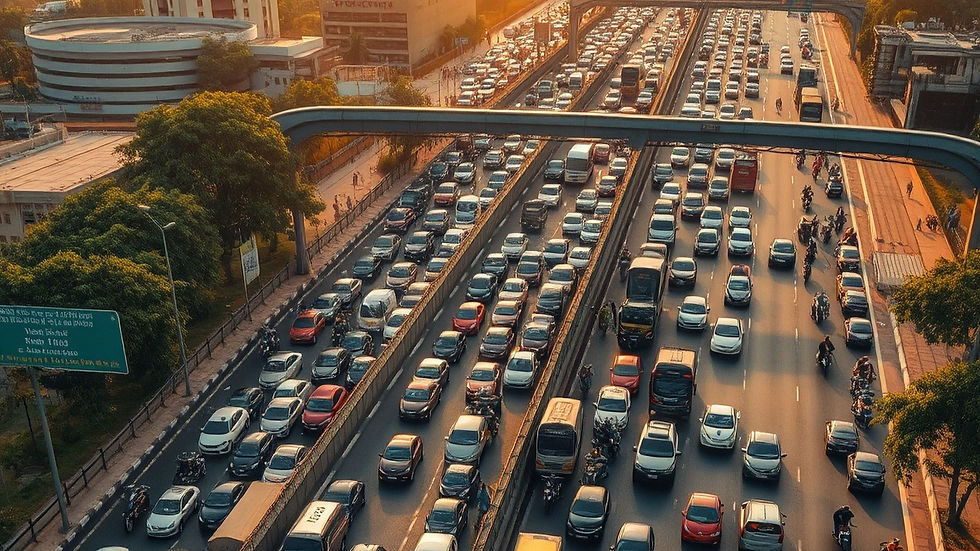
The pandemic forced the world's largest unplanned experiment in remote work. Millions of knowledge workers went home. Quarterly targets were met. Some companies grew faster than ever. And employees — freed from punishing commutes averaging 63 minutes one way in Bengaluru and 55+ minutes in Delhi and Mumbai — reported higher satisfaction, better focus, and more time for life outside work.
The result was clear: the office is not required for output.
That should have been a design brief, not a death sentence. It should have prompted the question: if people don't need to come to the office, what would make them genuinely want to?
Instead, the C-suite issued mandates.
What the Data Actually Says
Before we talk design, let's be honest about the numbers:
Remote-only workers achieve 29 more minutes of productive work per day than office-based counterparts, and 57% of employees report higher productivity working remotely (Source: ActivTrak 2025 State of the Workplace Report)
Fully remote companies grew revenue 1.7x faster from 2019 to 2024 than office-required firms (Source: Founder Reports RTO Statistics, 2026)
Gartner found zero measurable productivity gains from RTO mandates, while Gallup reported employee engagement at 10-year lows following RTO policies
87% of employees want flexibility, with many willing to change jobs to keep remote options (Source: Zety RTO Divide Report, 2025)
One honest caveat: a 2024 NBER study found fully remote work can reduce output by ~18% in highly interdependent, collaborative roles. That's real. But it's an argument for intentional hybrid design — not five-day attendance enforcement.
The data doesn't support forced full-time return. It supports purposeful presence.
The Real Reasons Behind 5-Day RTO Mandates
If productivity data doesn't justify these mandates, what does? The honest answer involves several uncomfortable truths — none of which are primarily about employee performance.
Real estate sunk costs. Companies signed 10–15 year leases they cannot easily exit. Even after aggressive RTO pushes, global office utilization sits at just 50–65% of pre-pandemic levels (Source: SoftwareSeni RTO Analysis, 2025). McKinsey estimates urban office demand will fall 13% by 2030, putting $800 billion in real estate value at risk. Filling seats is balance sheet management — not a productivity strategy.
Stealth workforce reduction. A BambooHR survey found 25% of C-suite executives and VPs admitted they wanted RTO policies to lead to voluntary turnover — avoiding the cost and scrutiny of formal layoffs. The employees most likely to walk are the senior, the skilled, and the mobile. Headcount reduction without a single severance cheque.
Executive psychology. University of Pittsburgh research found RTO mandates correlate strongly with powerful, senior leadership profiles (Source: CNBC, 2025). These leaders exhibit what behavioral economists call input bias — equating physical presence with performance. It's a management comfort mechanism, not evidence-based strategy.
Stock price theater. S&P 500 data shows companies are significantly more likely to mandate RTO after their stock prices fall (Source: CNBC / University of Pittsburgh, 2025). When boards are restless, a dramatic policy announcement fills the silence. RTO is a press release dressed as strategy.

Here's Why This Is a Design Problem
Every time a company issues a blunt five-day RTO mandate — with no investment in the space, no rethinking of the environment, no answer to "why would someone want to come here?" — they send employees back into the same office they fled in 2020.
The same open-plan floors designed for heads-down individual work.The same meeting rooms with poor acoustics and worse AV.The same 90-minute commute bookending a day that could have been spent in focused, uninterrupted deep work.
And when those employees — burnt out by the commute, distracted by the noise floor, sitting in back-to-back video calls that could have been emails — produce less than they did at home, the conclusion drawn is never "our space failed them." It's "remote work made them lazy."
Poor space plus forced attendance equals a failed experiment that blames the worker.
This is how the office loses its reputation. Not because offices are inherently flawed. Because the policy surrounding them is intellectually dishonest.
What Good Office Design Actually Promises
The best workplace research consistently shows that employees want to come to offices that offer something their homes genuinely cannot:
Purposeful collaboration zones designed for creative friction and team problem-solving
Social infrastructure — the informal, serendipitous connections that build real culture
Focus environments with acoustic privacy better than a kitchen table in a studio apartment
Experience and identity — spaces that make people feel they belong to something larger than a Zoom grid
The office that earns attendance doesn't need a mandate. It needs a reason. And that reason has to be designed — spatially, programmatically, experientially.

The Policy and the Design Are in Conflict
Here is the central contradiction of the current moment:
Good office design argues that space should earn presence. Poor RTO policy argues that presence should be mandated regardless of space.

When companies force employees back into mediocre environments through top-down policy, they don't validate the office — they weaponize it. Every employee sitting in a poorly designed open floor, commuting 2+ hours a day, doing work they could have done better from home, becomes a walking argument against investing in workspace.
The companies doing the most damage to the case for good office design aren't the ones going remote-first. They're the ones mandating attendance without asking what the office needs to offer in return.
What Should Actually Happen
The answer isn't "everyone stays home forever." The answer is honest, and it starts with four commitments:
Audit why you're calling people back. If the answer involves lease obligations or headcount reduction, don't dress it up as culture investment.
Design for intentional presence. Define what the office does better than home — and invest in making it genuinely true, not just aspirationally decorated.
Let attendance be a product of experience, not enforcement. If your office is worth coming to, people will come. If it requires a mandate, your space has a brief it hasn't answered yet.
Measure outcomes, not presence. An analyst producing exceptional work from home three days a week is more valuable than a disengaged employee clocking five days in a hot-desking pod.
The Bottom Line
The office has a powerful future — but not the one being built by blunt mandates and sunk-cost real estate decisions.
The future of the office is earned, not enforced. It is a destination that offers what a home screen cannot. It is designed with intention, occupied with purpose, and measured by the quality of what happens inside — not the headcount of who showed up.
Poor RTO policy is doing more damage to the office's reputation than remote work ever did. As workplace designers and analysts, that is the conversation we believe the industry needs to have — openly, honestly, and urgently.

Views expressed are those of the authors and do not represent the views of any affiliated organizations.
Great insights.